Netomi: Complete Guide to Features, Pricing & Limitations (2026)
Netomi runs AI agents for United Airlines and DraftKings by chat, email and voice. Its site shows no price and there is no self-serve trial. Our 5.5/10 verdict.
Summarize with AI
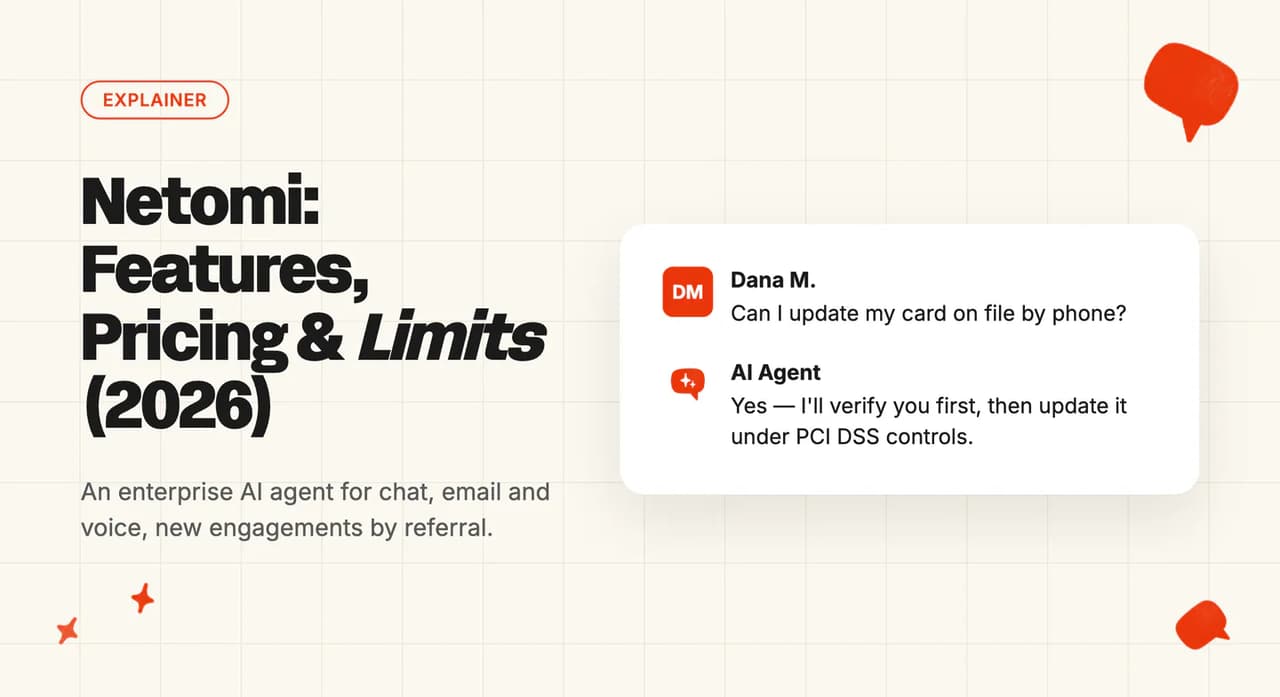
If Netomi is on your radar, someone else probably put it there. A peer at a bigger company mentioned it, a story about Accenture's investment showed up in your feed, or a consultant added it to your shortlist.
Then you go looking for detail and find a list of famous clients with very little about the product itself. There is no price, no product tour and no sign-up form, so the questions you need answered before a budget meeting stay open.
Netomi AI customer service software puts AI agents in front of the customers of very large brands by chat, email and phone. It works on top of the helpdesk, CRM and contact center systems a company already has (there are apps for Zendesk and a listing on Microsoft's software marketplace). The company behind it, Netomi, is based in San Mateo, California, and run by its founder and CEO, Puneet Mehta.
I'm Mike, co-founder of My AskAI. We build an AI agent that 200+ ecommerce and SaaS businesses run inside the helpdesk they already use, so I have a stake in this market. The answers to those open questions come from Netomi's contract, its security page, its marketplace listings and what its customers have said on the record.
Netomi at a glance
| Fact | Detail |
|---|---|
| What it is | Enterprise AI agents for chat, email and voice |
| Headline price | Not on Netomi's site; set per Order Form |
| G2 rating | 4.8/5 from 16 reviews |
| Best for | Very large brands needing voice and compliance |
| Not a fit for | Teams wanting a public price and self-serve trial |
| Biggest limitation | No price on its site; no self-serve trial |
| Our verdict | 5.5/10 |
What is Netomi?
The Netomi platform is made up of these parts:
- An autonomous agent - talks to customers on its own and handles anything from "resolving common requests to handling complex, multi-step workflows", in the words of the announcement of Accenture's investment
- Agent assist - AI that sits beside your human agents in their helpdesk and suggests what to say and do next
- A no-code studio - where your CX team sets the agent's tone, policies, knowledge and actions without writing code (so a support lead can own the day-to-day)
Netomi's Microsoft marketplace listing describes the product as "an enterprise-grade AI platform built for brand-safe customer and employee experiences." It is a layer over your existing tools, so you keep your helpdesk and CRM. I think that is the right call for a brand this size, since nobody wants to rip out a contact center just to try an AI agent. The listing's product sheet names Microsoft Azure, Dynamics and Teams among the systems it connects to, and Netomi's apps run inside Zendesk.
Puneet Mehta founded the company under an earlier name and later renamed it Netomi, according to its company history. Its latest round was a $110 million Series C led by Accenture Ventures, with Adobe Ventures, WndrCo and others taking part. OpenAI is a partner too (Netomi's agents run on its models).
New engagements are by referral, according to Netomi's website. In practice, that means an enterprise contract and a rollout run largely by Netomi's team.
The G2 review that stuck with me talks about money:
"Training our AI to resolve and deflect thousands of tickets has saved our company millions of dollars." Olivia C., Customer Experience Manager, via G2, where Netomi scores 4.8/5 from 16 reviews.
How easy is it to set up Netomi?
There is no account you can open yourself, so setup follows the sales process. From there the work is people-led, and Netomi's job listings show how. It hires into teams called Agentic Delivery and Global Field Engineering, and its Agentic Product Manager is responsible for "designing, architecting, and deploying large-scale Agentic AI solutions for enterprise customers". I read that as good news for a big brand, because someone experienced does the heavy lifting with you.
The product sheet on Netomi's marketplace listing splits the build into six stages:
- Discovery - reviewing your past support conversations to decide what the agent should handle first
- Configuration - setting up the agent, its knowledge and the actions it can take
- Testing - checking its answers against test cases before anything goes live
- Release management - keeping draft, staging and live versions apart (so an untested change never reaches customers)
- Insights - analytics on how conversations are going
- Optimization - improving the agent from what those analytics show
I like how much of the tuning Netomi hands to business users. Its studio page set out the job as "Define your agent's personality, behavior, and boundaries in plain English". Netomi has published one go-live time, for a streaming launch:
"At Paramount, Netomi was deployed for Paramount+ over chat and voice in just two weeks", via Netomi's Series C announcement.
If you run Zendesk, you build the agent in Netomi's studio and switch it on from your Zendesk admin. For chat, the messaging app's listing adds a condition:
"All Messaging bot integrations will require you to have Sunshine Conversations access and usage purchased or included in your plan."
A Zendesk chat customer may pay Zendesk for that add-on on top of Netomi.
What channels does Netomi work in?
Netomi's agent works "across chat, email, and voice", as the Accenture investment announcement puts it. Netomi's marketplace listing gives the fuller set:
- Chat and messaging, on the web and inside mobile apps
- Telephony and voice
- Search and social channels
- Microsoft Teams, for employee-facing help
I think voice is one of Netomi's strengths, because the same agent answers the phone and the chat window. In-app chat works at airline scale too: "Netomi powers the United Airlines Chat AI found in the United mobile app," according to Netomi's Series C announcement.
When a conversation needs a person, Netomi's Autopilot page set out handover by business rule, by customer sentiment and by customer type, so a VIP can go straight to a human. The conversation's context goes with it, which saves the customer from repeating themselves.
What are the limitations of Netomi?
I think Netomi's limits hit hardest on a team that wants to price and test a tool before it talks to sales, or that is smaller than Netomi's usual client.
No price before a proposal
Netomi's website has no pricing page, and its homepage states that new engagements come by referral. Its customer contract says fees are "set forth in the applicable Order Form" (the contract you sign at the end of a sales process). Until you have that proposal, there is no number to put in front of your finance lead.
Little to check before the first call
Most of what a buyer would want to read is open only to customers. Product documentation needs a customer login, and Netomi's help center holds no public articles. Security paperwork is "available to customers and active evaluations under NDA", according to its security page.
Built for the very largest brands
Every client Netomi names on its homepage is a household name, from Delta and MetLife to the NBA and Coach. I find the list reassuring about scale. It also means there is little public evidence of how Netomi works for a team of ten agents, and Netomi builds its sales and delivery model around big enterprise projects.
Results depend on Netomi's people
Because Netomi's engineers build and tune much of the agent, the quality of your account team decides a lot about your results. Reviewers on G2 praise Netomi's customer success managers, and one mentions working through several before settling on the right one. Ask who Netomi will assign to your account, and what happens if that person moves on.
What knowledge sources can I train Netomi on?
Netomi pulls your written knowledge and your business systems into one place the agent can answer from. Its studio page said: "Connect your knowledge bases, CMSs, websites, and offline documentation. Netomi ingests and indexes it all, keeping your agent's knowledge current automatically." The examples named there include Salesforce, Confluence, SharePoint, PDFs and spreadsheets.
Netomi's marketplace listing groups these into approved knowledge sources, CRM and case management records, and other business systems. The agent can then answer from what is written down and look up a customer's records when a question needs them.
Of those sources, I put the most weight on your past conversations, because they show how your team answers. The build starts with "Analysis of historical support interactions", and an older Zendesk listing described the agent's ability to "Train from historic email, chat and messaging data". Netomi can learn from those replies as well as from your articles, which helps when your help center is thin.
What features does Netomi have?
Netomi's features split into an agent for your customers, help for your human agents and tools for keeping watch over both.
The autonomous agent
The customer-facing agent answers questions and completes requests in your other systems. Netomi's platform overview listed payments, orders, reservations, identity checks and loyalty programs among the systems it acts in. I value the actions most here, because an airline or a retailer can let the agent finish a rebooking or an order change without the customer waiting for a person.
Agent assist inside your helpdesk
For the conversations your team still handles, Netomi has an Agent Assist app on the Zendesk Marketplace, offering "Netomi's AI-driven contextual support and suggestions for agents". Netomi's Co-Pilot page described it drafting replies from approved knowledge, recommending the next step and writing a summary when the conversation ends. The Zendesk apps are free to install (the Netomi subscription is billed separately).
Our roundup of AI agent-assist tools covers how copilots of this kind compare.
Oversight and control
The live listing describes governance with "confidence scoring, fallback logic, live audit trails, and observability", plus a Response Analyzer and a Conversation Viewer. For a support leader, that means you can open any conversation and see why the agent said what it said. It also means the agent can fall back to a safe answer or a human when it is unsure.
How do I improve Netomi responses?
The improvement loop runs inside the studio. According to the product sheet on Netomi's marketplace listing, it generates test conversations to check answers before a change goes live, and the studio keeps draft, staging and production versions of each action apart. Netomi's studio page also described an AI observer that "surfaces prioritized opportunities for improvement".
Netomi's delivery engineers do a large share of this work, which suits a team that wants a vendor running the project. Even so, keep someone on your side reading a sample of conversations each week, so you see what your customers see first-hand.
What resolution rate can I expect from Netomi?
Netomi's clearest published result is a resolution figure, which counts tickets the AI handled without an agent stepping in. It is vendor-reported, so take it with a grain of salt. The Series B announcement names "WestJet Airlines, which uses the company to resolve 87% of its support tickets across Web chat, Facebook Messenger, Google Assistant and WhatsApp."
Other published numbers about Netomi measure speed and understanding. A customer story from its model provider reports that DraftKings saw traffic above 40,000 concurrent requests a second during major sporting events. Responses came back in under three seconds, with 98% accuracy at recognizing what customers were asking.
Our benchmark study of published AI resolution rates covers 195 rated deployments from 38 vendors, and the median is 70%. That figure comes with three cautions:
- It describes the whole field and ranks no vendor.
- Vendors measure different things under the same word, so the numbers are directional.
- Published figures are wins vendors chose to share, so a typical deployment probably resolves fewer.
What AI model does Netomi use?
Netomi is built on OpenAI's models. The customer story explains the split: GPT-4.1 handles the quick, predictable steps such as looking up a booking, and GPT-5.2 plans the harder requests that take several steps. For your customers, that keeps simple questions fast.
The studio also lists model management among its features on Netomi's marketplace listing, and Netomi's earlier homepage offered "Bring your own LLM or use ours" (an LLM is the large language model that writes the replies). If your company has already approved a particular AI provider, ask whether Netomi can run on it, since that can shorten your security review.
What languages does Netomi work in?
Netomi's Zendesk partner page says the agent "understands 100+ languages", a figure Netomi also gave in its Series B announcement. Netomi's marketplace listing names multilingual management among the studio's features, and the analytics view includes a breakdown of the languages customers use.
How secure is Netomi?
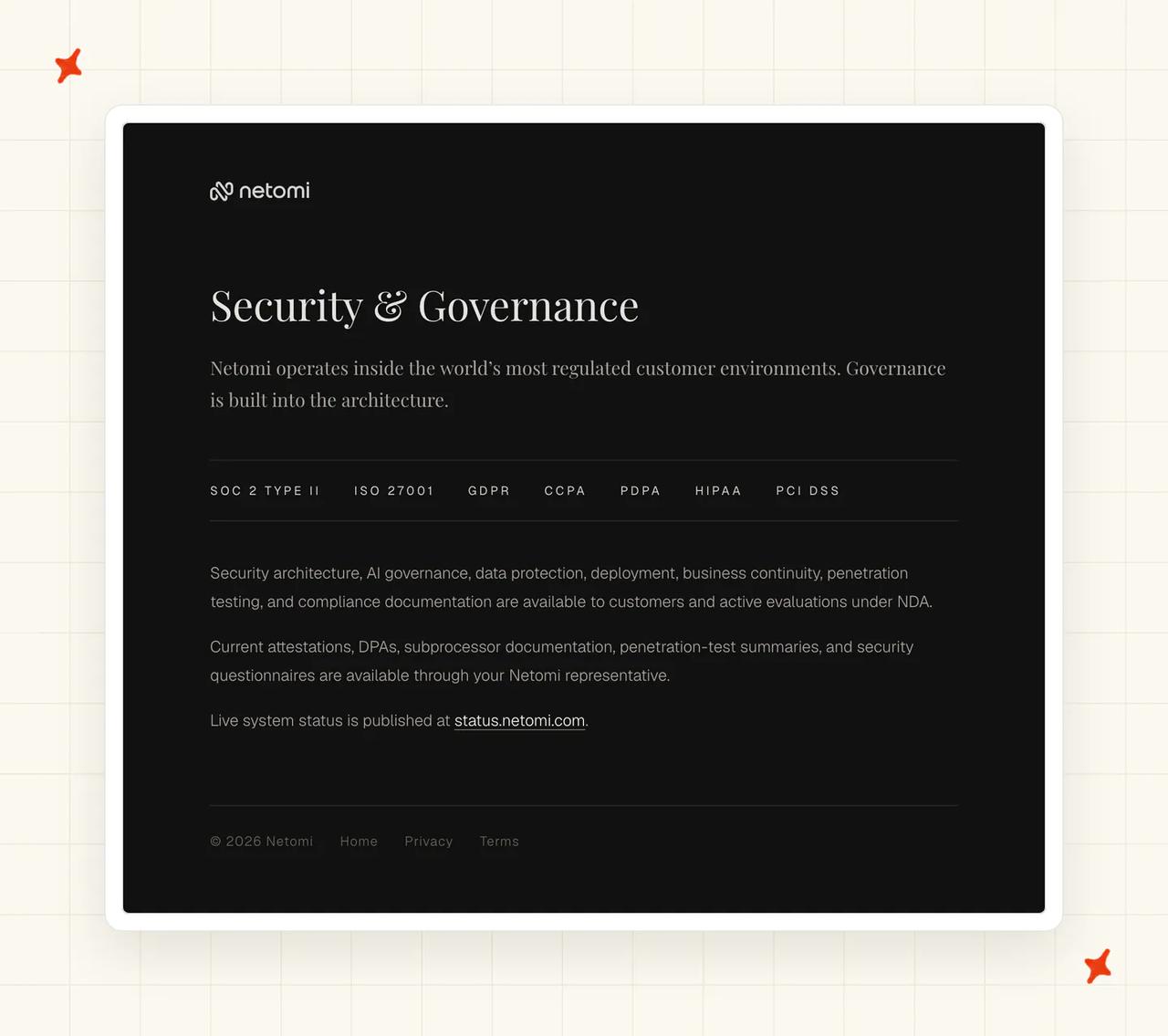
I rate security as one of Netomi's strongest areas. Its security page lists these standards:
- SOC 2 Type II - an independent audit of how a vendor runs its security controls
- ISO 27001 - the international standard for managing information security
- GDPR, CCPA and PDPA - privacy law in Europe, California and parts of Asia
- HIPAA - required before a vendor handles patient health data
- PCI DSS - required before a vendor handles card payment data
Netomi shares the reports themselves, along with data processing agreements, penetration test summaries and security questionnaires, with customers and active evaluations under NDA. Your security team can start that request as soon as the sales conversation begins. Netomi also runs a public status page showing uptime.
Our guide to AI customer service security and compliance covers what to ask any vendor during that review.
Who is using Netomi?
Netomi's homepage lists Delta, United, MetLife, DraftKings, NBA, Equinox, Virgin Voyages and Coach among its clients. Three clients have public detail on how they use Netomi:
- United Airlines - Netomi runs the AI chat inside the United mobile app, according to its Series C announcement
- DraftKings - the sports betting company handles huge spikes during major sporting events, described in a customer story from Netomi's model provider
- WestJet - the airline resolves 87% of its support tickets with Netomi, by Netomi's account
Netomi's clients span airlines, streaming and gaming, and they share very high volume that arrives in bursts. A reviewer on G2 described it:
"Netomi's AI helps us handle spikes with ease." A G2 reviewer, via G2.
How much does Netomi cost?
How does Netomi price a contract?
Netomi's customer contract sets fees in each customer's Order Form, invoiced in US dollars on terms that renew automatically. The contract names no billing unit such as a conversation or a resolution. The closest outside figure comes from procurement data on what buyers report paying, where the median contract is $85,000 a year (a rough guide only, since it mixes deals of every size).
Netomi also lists its platform on the Microsoft marketplace, so a company that buys software through Microsoft can run the contract through there. The figure shown on that listing is a nominal placeholder.
My list for a first call with Netomi has four questions on it:
- What counts as a billable conversation or resolution, and who decides?
- Is voice priced separately from chat and email?
- What does a pilot cost, and how does it turn into a contract?
- How can the price change at renewal?
Our explainers on outcome-based pricing and on per-conversation versus per-resolution pricing cover how each model behaves as your volume grows.
What do 10,000 conversations a month cost?
To put a number next to Netomi's quote, I've priced out a support team handling 10,000 conversations a month. The comparison rests on three assumptions:
- 10,000 customer conversations a month across chat and email
- A contact handled by a person costs $8.01 on average, according to an industry analyst estimate for live channels
- Each AI option sits on top of the helpdesk seats you already pay for, so its row is the AI charge alone
Each AI option is priced on its lowest plan that covers 10,000 conversations, set against a team answering every one by hand.
| Option | How it is priced | Monthly cost |
|---|---|---|
| No AI (baseline) | Your team answers all 10,000 at $8.01 each | $80,100 |
| My AskAI | Scale plan: $499 + $0.10 × 8,000 tickets above the 2,000 included | $1,299 |
| Netomi | Set in each customer's Order Form | Quoted per deal |
Every conversation the AI resolves is one your team no longer answers at $8.01, so the saving grows with your resolution rate. Netomi's figure stays unknown until you have a proposal in hand.
Does Netomi have a free trial?
You cannot sign up and try Netomi on your own, and its homepage says new engagements come by referral. Its customer contract provides for a proper pilot, covering services on "a proof-of-concept, pilot, evaluation, beta, or trial basis, as designated in the applicable Order Form".
I think the terms are generous once you get there. The pilot runs for the period in the Order Form, "or if none is stated, thirty (30) days". On price, the contract says "Except as otherwise specified in an Order Form, Trial Services are provided at no charge."
The pilot is "not intended for production use", so plan to test on real tickets without putting it in front of live customers.
Is Netomi worth it?
The split I see is between a buyer who wants the vendor's team to run the project and one who wants to price and test the product first.
If you are weighing Netomi against other enterprise vendors bought through a sales team, Sierra, Decagon and Ada are its closest peers, and we have written a complete guide to each. Our roundup of the best AI customer service for enterprise covers the wider field.
What are the Pros and Cons of Netomi?
Most of Netomi's strengths serve a global brand.
Pros
- Chat, email and voice on one agent at very large volumes - the same agent across chat, email and voice, including chat inside United's mobile app.
- A broad first-party compliance list - SOC 2 Type II, ISO 27001, HIPAA and PCI DSS among others.
- Named enterprise customers across airlines, insurance and gaming - a client list that includes Delta, United, DraftKings and MetLife.
Cons
- No price on its site, quoted per deal - fees are set in each customer's Order Form, so there is no figure for a business case before a proposal.
- No self-serve trial - a no-charge pilot exists, but only after a signed Order Form.
- Little product detail public before a sales conversation - documentation sits behind a customer login and security paperwork under NDA.
- Results depend on the vendor's success team - Netomi's engineers build much of the agent, so the quality of your account team affects the outcome.
How does Netomi's rating break down?
Four scores make up the overall rating:
- Product: 7/10 - an agent that answers and acts across chat, email and voice, agent assist in the helpdesk and a studio with testing and versions, held back because much of the tuning runs through Netomi's team
- Price and trial: 4/10 - no price on Netomi's site, fees set per contract and no self-serve trial, lifted by a contract that provides no-charge pilots of 30 days by default
- Setup and fit: 5/10 - it sits on top of the systems you keep, but setup runs through Netomi's engineers, Zendesk chat needs a Zendesk add-on, and every named client is a very large enterprise
- Evidence: 6/10 - named clients, first-hand figures from DraftKings and a first-party certification list, held back because documentation sits behind a login and security paperwork under NDA
Scored on the sections above, from Netomi's own pages, its contract and published customer detail, gaps included. It isn't higher on cost and trial, because Netomi's site shows no price and there is no way to test before a signed Order Form. It isn't lower because its customer evidence is public, with detail on how United and DraftKings use it.
FAQs
What exactly does Netomi do?
Netomi builds AI agents that answer customers and complete requests across chat, email and voice for very large brands. It also offers agent assist for human agents and a no-code studio where the CX team sets the agent's tone, knowledge and actions (all on top of the helpdesk and CRM a company already runs).
What is Netomi AI?
Netomi AI is the enterprise agent platform sold by Netomi, a company based in San Mateo, California. It runs an autonomous customer-facing agent, agent assist inside helpdesks such as Zendesk (for the conversations your human team still handles), and analytics that show why the agent answered as it did.
Who is the CEO of Netomi?
Puneet Mehta is Netomi's founder and CEO. He started the company under an earlier name and still leads it, according to its company history.
Is Netomi a startup?
Netomi is a venture-backed private company that started under a different name and has raised money through to a Series C. My read is that it is well past the early-stage startup phase, since Netomi's company profile puts its headcount at 201 to 500 employees and its clients include Delta, United and MetLife.
How much funding has Netomi raised?
Netomi's latest round was a $110 million Series C led by Accenture Ventures, with Adobe Ventures, WndrCo and others taking part. Earlier rounds were a $14.7 million Series A led by Index Ventures and a $30 million Series B led by WndrCo.
How much does Netomi cost?
Netomi's website has no pricing page, and fees are set in each customer's Order Form after a referral and a scoping conversation.
What are the best Netomi alternatives?
Does Netomi work inside Zendesk as an agent assist tool?
Yes. Netomi has an Agent Assist app on the Zendesk Marketplace that gives human agents suggestions and context inside the ticket, and it is set up from Netomi's studio. The app is free to install (the Netomi subscription is billed separately).
Is Netomi a chatbot?
Partly. Its agent answers from your knowledge, completes requests in your other systems (an order change, say), works on email and voice as well as chat, and hands over to a person with context when it needs to.
Is Netomi SOC 2 compliant?
Yes. Netomi lists SOC 2 Type II on its security page, alongside ISO 27001, GDPR, CCPA, PDPA, HIPAA and PCI DSS. The reports are shared with customers and active evaluations under NDA.
What AI model does Netomi use?
Netomi runs on OpenAI's GPT-4.1 for fast actions and GPT-5.2 for requests that take several steps, according to a customer story from its model provider. Its studio also manages more than one model (useful if your company has already approved a particular AI provider).
Does Netomi have a free trial?
There is no self-serve trial. Netomi's contract provides no-charge pilots, 30 days by default, once a referral and a signed Order Form are in place, and the pilot is for evaluation rather than live customers.