eesel AI Pricing Explained: What You Actually Pay Under the New Pay-as-You-Go Model
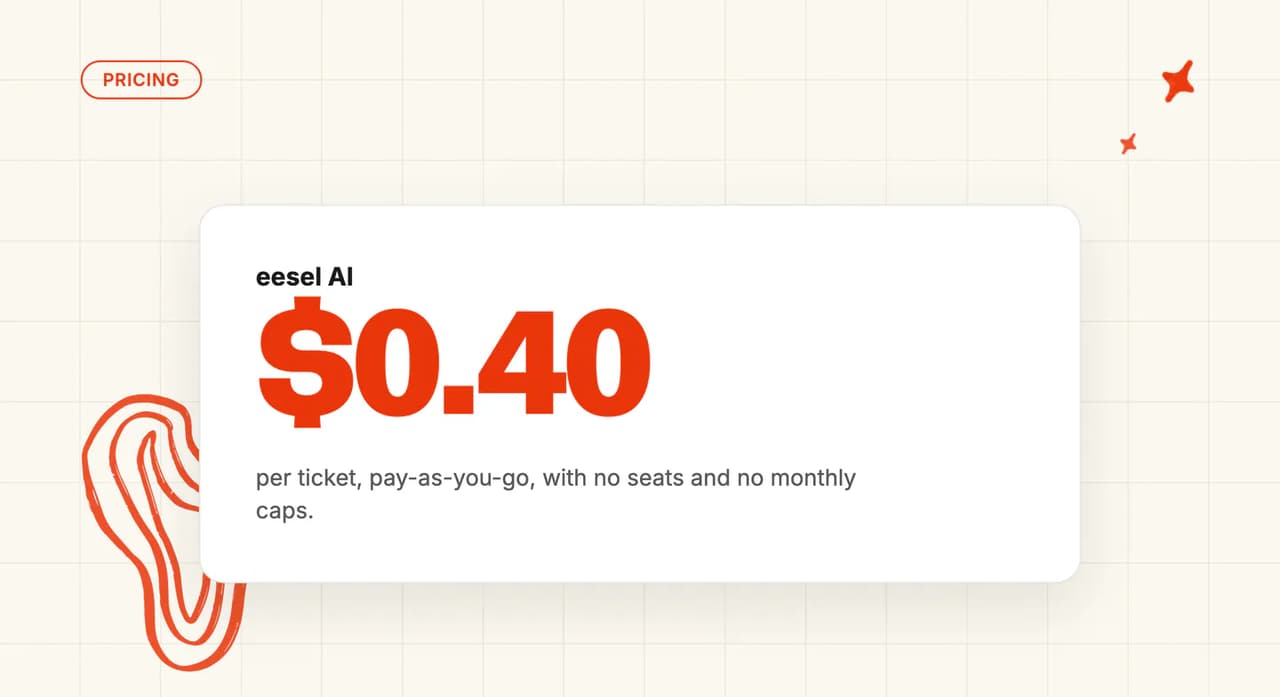
eesel AI pricing moved to pay-as-you-go: $0.40 per ticket, no seats or caps. My AskAI starts at $0.10 a ticket. What you pay at 1k, 10k and 50k tickets.
Summarize with AI
If you've landed here, you probably went to check eesel's pricing and found something different from what every review and blog post told you to expect. You're not imagining it (I had to double-check the page myself).
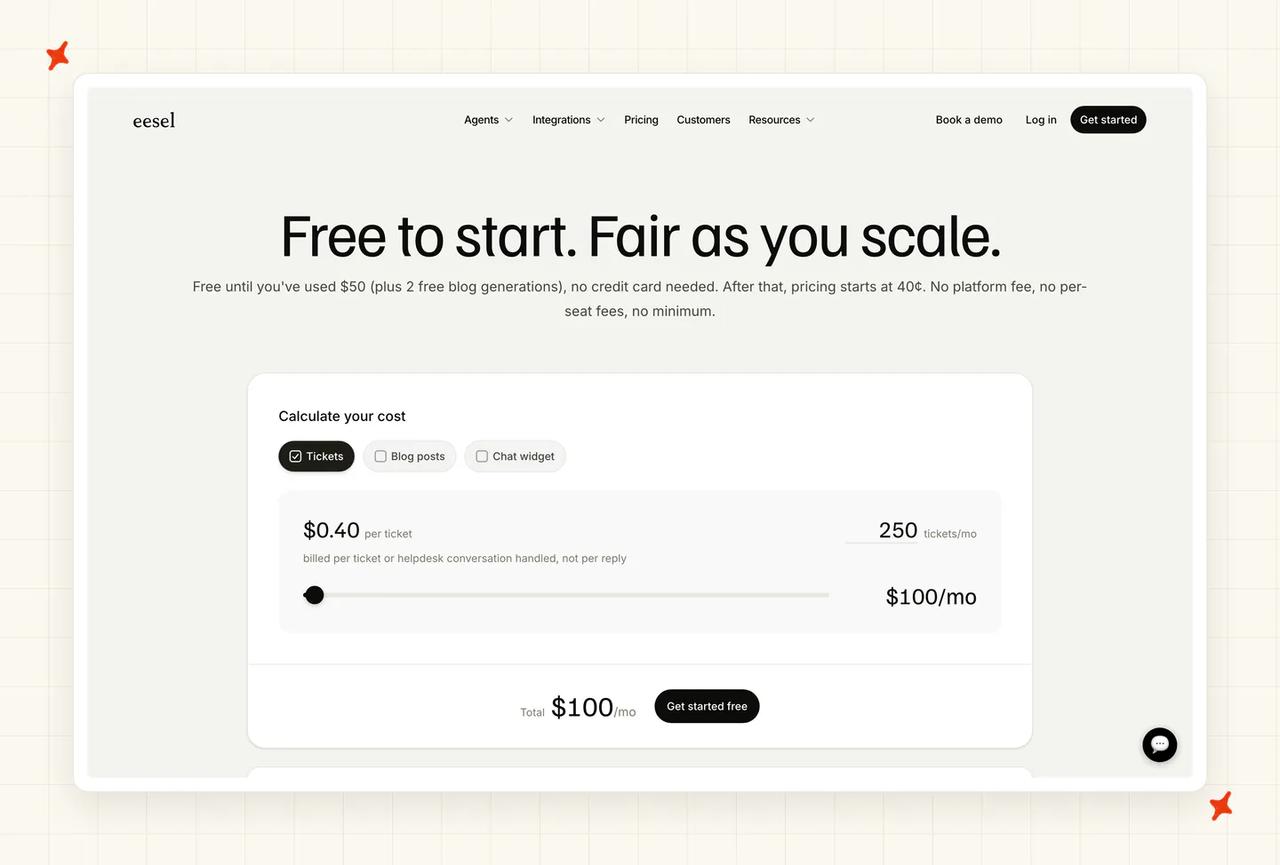
eesel has thrown out its old tiered plans. Gone are the $239 Team plan, the $799 Business plan, and the interaction caps that switched the AI off mid-month. In their place is a flat, pay-as-you-go model built around a single number: $0.40 a ticket.
You're here because one of these is true:
- You saw the new $0.40 figure and want to know what it adds up to at your volume.
- You read an older breakdown quoting $799/month and need to know which one is right (the $0.40 one is).
- You're comparing eesel against the cheaper options and want the real cost behind the sticker price.
Your bill is really $0.40 divided by your resolution rate, and I've worked that out below at 1,000, 10,000 and 50,000 tickets a month. The alternatives are in the mix too, at the same volume, with real numbers in place of "contact sales" answers.
How does eesel AI pricing actually work?
eesel now charges by the task. A task is one unit of work the agent does, and for support teams that means one ticket or one chat (the unit you'll actually be billed on). There are three types, and the price depends on the type.
| Task type | Price | What it covers |
|---|---|---|
| Light | Free | Dashboard chats and quick lookups |
| Regular | $0.40 per task | One helpdesk ticket or chat session, any number of messages |
| Heavy | $4.00 per task | Blog-post generation and complex multi-step jobs |
The big change is what's gone. There are no per-seat fees, no per-agent fees, and no monthly interaction caps that used to stop the AI once you hit a limit (a genuine improvement on the old model).
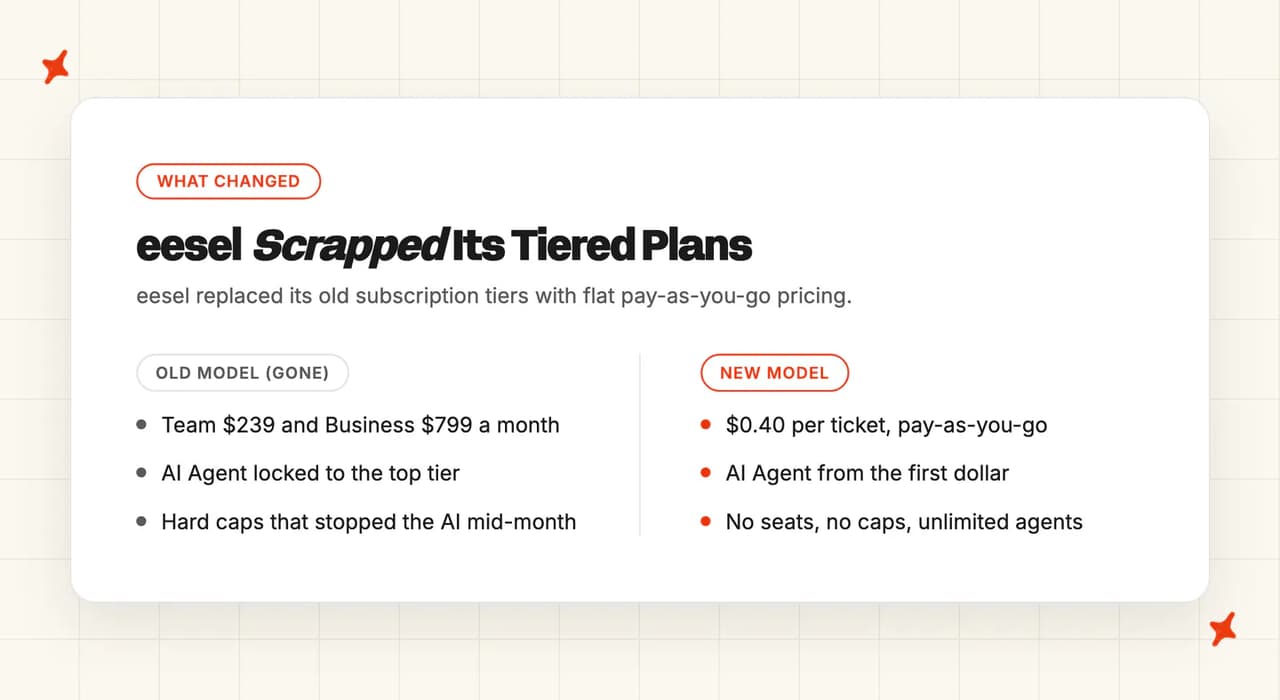
You get unlimited agents, unlimited integrations, and unlimited chats. The AI Agent that used to need the $799 plan is now just part of the pay-as-you-go rate.
Two more things sit on top of the per-task price. Annual billing saves you 25%, though I'd only commit once your volume is steady, since it needs a $300-a-month minimum. And there's an Enterprise plan at $1,000/month plus usage, which is where single sign-on, HIPAA and a signed BAA live.
What does each eesel task type cost, and what counts as a task?
eesel's own docs define a task as "one unit of work your agent performs, typically one helpdesk ticket or one skill invocation." For a support team, the everyday unit is the $0.40 Regular task.
The pricing page is clear that "one ticket or chat session equals one task, no matter how many messages go back and forth." So a five-message thread and a one-message reply both cost the same $0.40. That sounds generous, but I've found it helps less than it looks, since most tickets run only a few messages.
The volume examples eesel publishes line up with that $0.40 unit:
| Tickets per month | Monthly cost |
|---|---|
| 100 | $40 |
| 500 | $200 |
| 1,000 | $400 |
| 2,500 | $1,000 |
Heavy tasks are where the bill can jump. At $4 each they cost ten times a Regular ticket, so a workflow that leans on long-form generation adds up faster than the headline number suggests. I'd check what counts as a Heavy task in your setup before you sign anything.
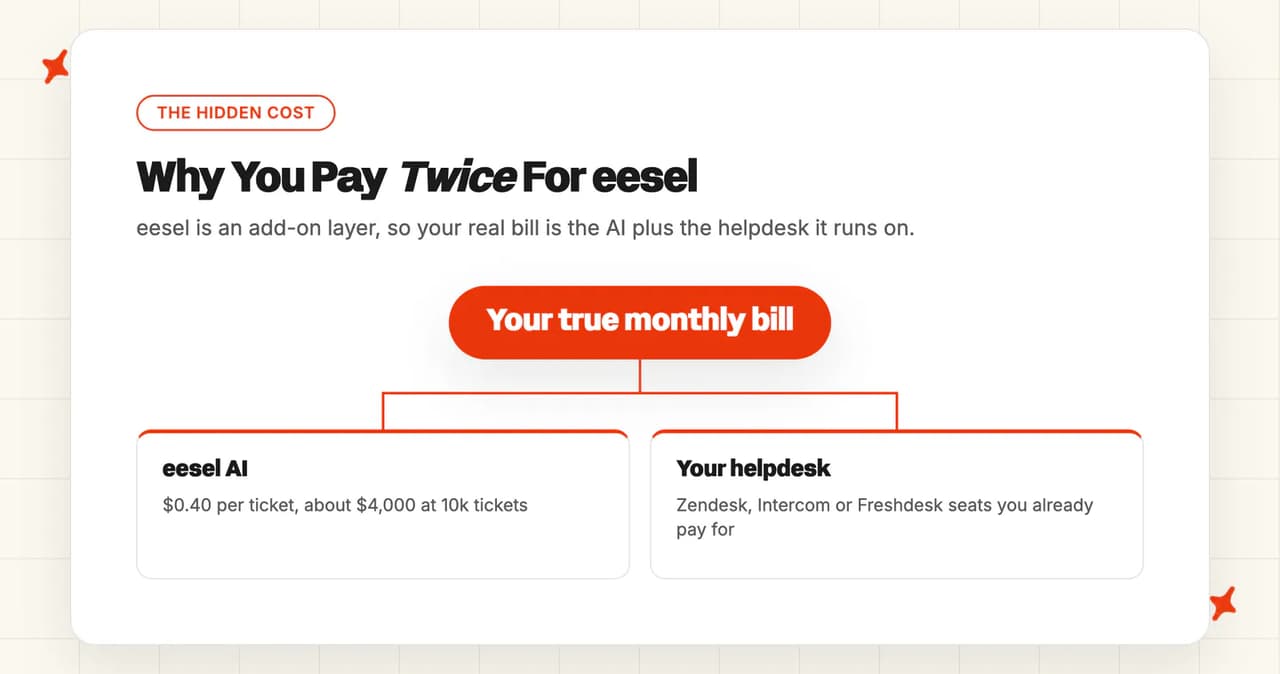
The bigger cost is one the page doesn't put in a table. eesel is an add-on layer that runs on top of a helpdesk. You still pay for Zendesk, Intercom, Freshdesk or Gorgias underneath, so your true bill is eesel plus whatever your helpdesk already costs.
What does eesel AI cost at typical support volumes?
Here's the math at three volumes. Under the old plans, eesel's caps meant only tiny teams got a clean published number. The new model is simpler: it's just tickets times $0.40, so it scales in a straight line.
At 1,000 tickets a month
| Assumption | Value |
|---|---|
| Tickets (Regular tasks) per month | 1,000 |
| Price per task | $0.40 |
| Monthly cost (list) | ~$400 |
| Monthly cost (25% annual) | ~$300 |
| Effective cost per resolved ticket at 70% | ~$0.57 |
| Effective cost per resolved ticket at 40% | ~$1.00 |
| Plus | your existing helpdesk cost |
At this size eesel is around $400 a month, or $300 on annual billing (which also meets the $300 minimum exactly). Add your helpdesk on top.
At 10,000 tickets a month
| Assumption | Value |
|---|---|
| Tickets (Regular tasks) per month | 10,000 |
| Price per task | $0.40 |
| Monthly cost (list) | ~$4,000 |
| Monthly cost (25% annual) | ~$3,000 |
| Effective cost per resolved ticket at 70% | ~$0.57 |
| Effective cost per resolved ticket at 40% | ~$1.00 |
| Plus | your existing helpdesk cost |
At mid-market volume you're looking at about $4,000 a month, or $3,000 on annual. There's no cap to trip over now, which is a real improvement on the old model.

At 50,000 tickets a month
| Assumption | Value |
|---|---|
| Tickets (Regular tasks) per month | 50,000 |
| Price per task | $0.40 |
| Monthly cost (list) | ~$20,000 |
| Monthly cost (25% annual) | ~$15,000 |
| Effective cost per resolved ticket at 70% | ~$0.57 |
| Plus | your existing helpdesk cost |
At high volume the flat unit keeps climbing in a straight line, so it's worth talking to eesel about Enterprise ($1,000/month base plus usage), where a negotiated rate is likely.
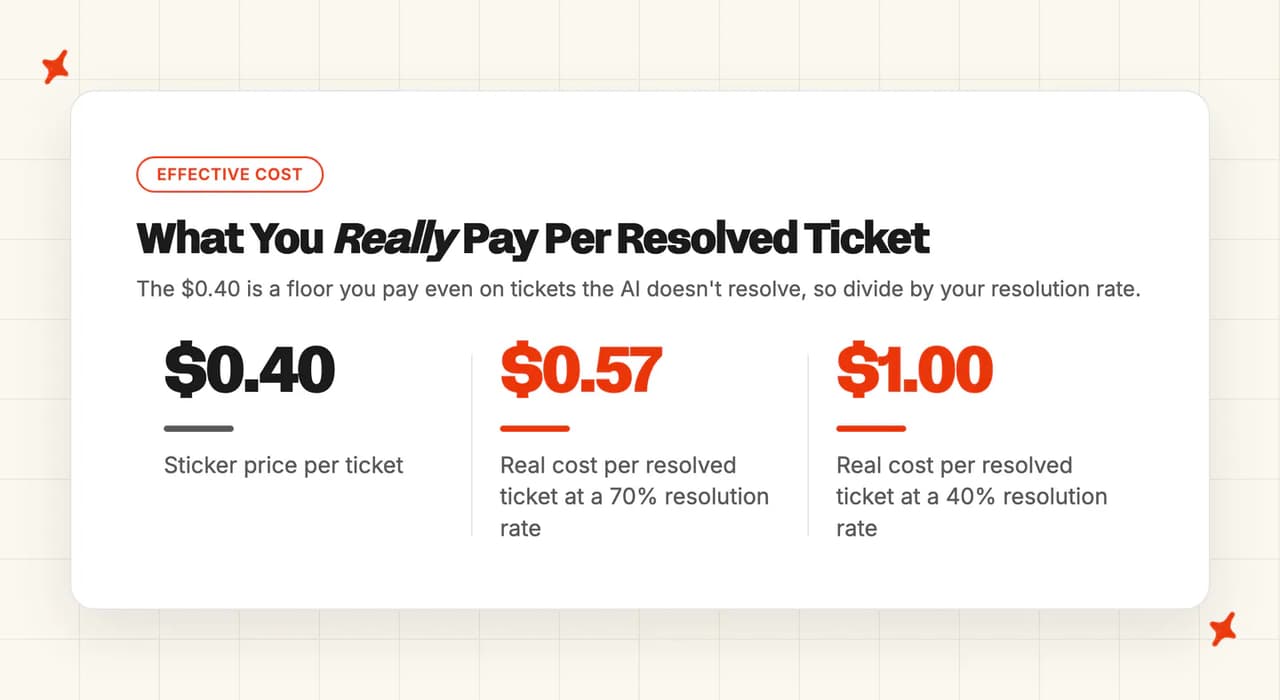
The effective cost per resolved ticket is what you're really paying for. You only get value from tickets the AI closes, so I'd treat the real unit as $0.40 divided by your resolution rate.
At a healthy 70% that's about $0.57 a resolved ticket, and at 40% it's about $1. The $0.40 is a floor you pay even on the tickets the AI doesn't close.
What the eesel pricing page doesn't tell you
The new model is cleaner than the old one, but a few costs still hide below the headline. I'd factor them in before you sign anything.
You're paying for two tools at once
eesel is a layer on top of your helpdesk, so your real bill is eesel plus Zendesk, Intercom or whatever you run. Your data flows through an extra platform, and in our experience, if your helpdesk already has its own built-in AI, you're partly paying twice for the same job.
$0.40 is a floor you pay on every ticket
You pay the $0.40 whether or not the AI resolves the ticket. So the effective cost per resolved ticket is $0.40 divided by your resolution rate: about $0.57 at 70% and over $1 if your rate is low. I'd do that division before you compare eesel to a per-resolution quote.
"Any number of messages" sounds better than it is
In our experience most support tickets, especially in ecommerce, are only a few messages long. So you rarely spread that $0.40 across a long conversation, which means on a per-message basis it's not cheap. The "unlimited messages per task" line matters far more for long, chatty threads than for the short exchanges most teams actually run.
A task is probably time-boxed
The docs describe a task as one ticket, but most per-ticket AI tools define that against a time window (often 24 hours), the way Freshdesk counts a session. eesel hasn't spelled out the exact window, so I'd ask whether a conversation that reopens a few days later counts as a fresh task.
Heavy tasks and the spend cap
Heavy tasks cost $4, ten times a Regular one, so any workflow that leans on them adds up quickly. And new accounts start with a default $250-a-month spend cap. It's adjustable, but if you don't raise it before a busy period, the agent can stop once you hit the limit.
What do real eesel customers say about the invoice?
There are few public billing complaints to dig into, which I read as a mild positive: no recurring bill-shock threads on Reddit or G2. The cost concern worth weighing is the structural one, the pay-twice setup covered above, rather than a surprise waiting on the invoice.
The biggest recent change is the price gate coming off. The editorial review at ToolsForHumans once called the entry plan "a limited preview at meaningful cost" because the AI Agent was locked to the $799 Business tier. That complaint is now out of date, since the pay-as-you-go model gives you the AI Agent from the first dollar.
On satisfaction, eesel scores 4.6 out of 5 on G2, though I'd weight the small review pool accordingly. Word-on-the-street backs the score up: the setup and simulation features get consistent praise.
Does eesel AI have a free trial, and what are the contract terms?
The trial is genuinely low-risk, and I'd use every day of it. You get seven days, $50 of free usage, and two free blog generations, with no credit card and every feature unlocked. That's plenty to run eesel against your real tickets and see a resolution rate before you pay.
The standard plan has no monthly minimum and no long-term contract, so you can stop when you want. New accounts do come with a default $250-a-month spend cap (I'd set it deliberately), which you can raise or lower at any time.
Annual billing is where the discount lives: 25% off, as long as you commit to at least $300 a month. And the Enterprise plan ($1,000/month base plus usage) is the one to ask about if you need single sign-on, HIPAA or a signed BAA.
How does eesel AI pricing compare to the alternatives at the same volume?
Here's the picture at 10,000 tickets a month, assuming a 70% resolution rate so the per-resolved numbers are comparable.
| Vendor | Pricing model | Cost at 10k tickets | Effective per resolved ticket |
|---|---|---|---|
| My AskAI | ~$0.10 per ticket (usage) | ~$1,000 | ~$0.14 |
| eesel AI | $0.40 per ticket (pay-as-you-go) | ~$4,000 | ~$0.57 |
| HubSpot Breeze | $0.50 per resolution + seats | ~$5,300 | ~$0.76 |
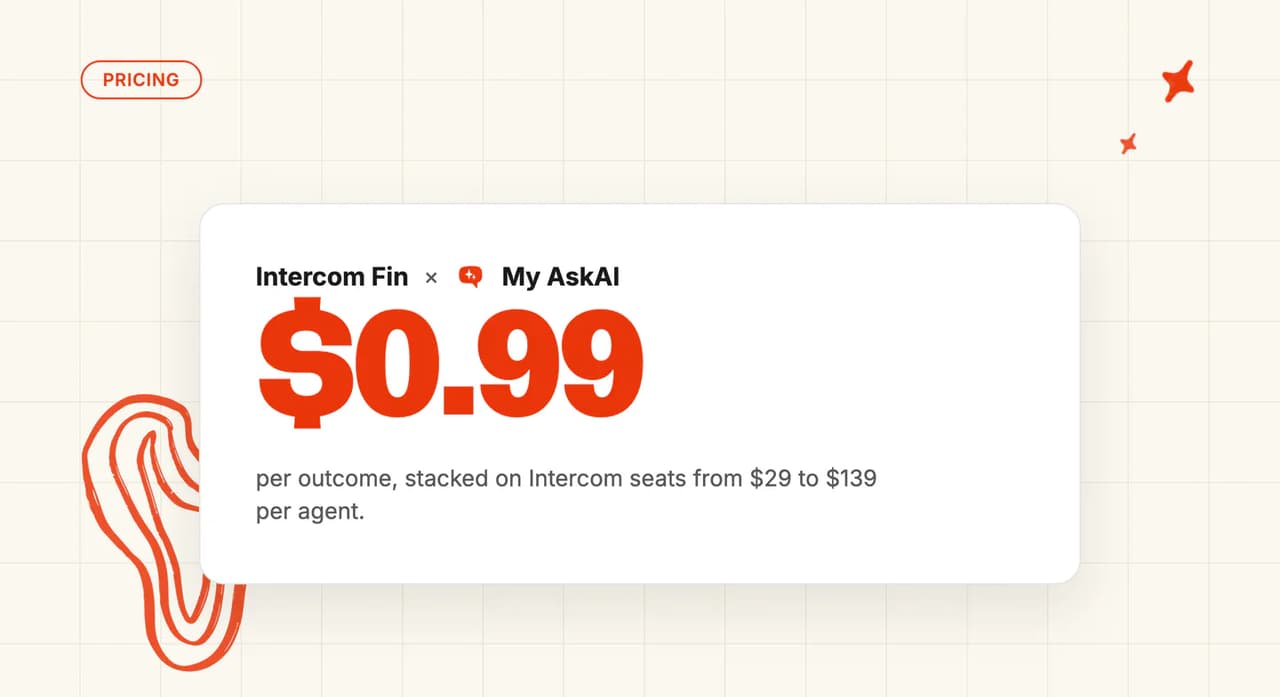
| Intercom Fin | $0.99 per outcome + seats | ~$8,600 | ~$1.23 |
eesel's flat $0.40 ticket is simpler to forecast than the per-resolution models, and at a healthy 70% resolution its ~$0.57 per resolved ticket actually undercuts both Intercom Fin and HubSpot Breeze. On price alone against those two, eesel can come out ahead.
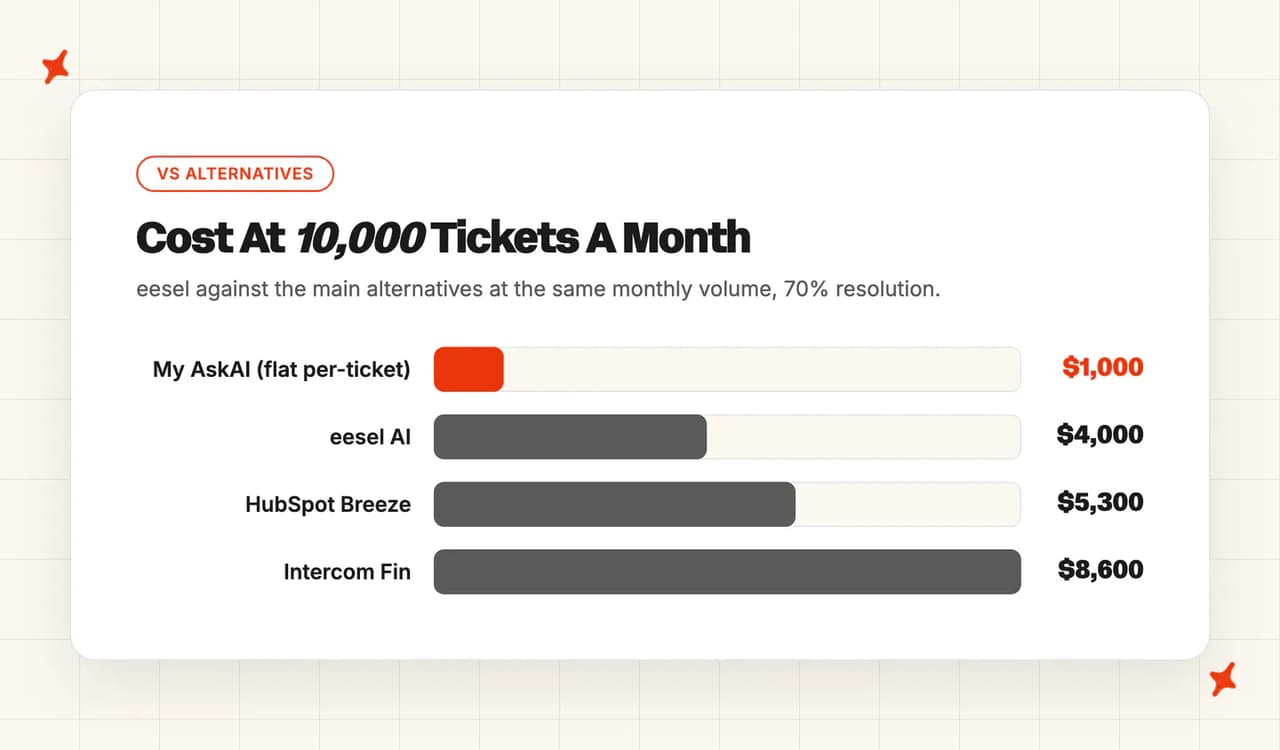
The catch is the two tools around it. eesel is roughly four times My AskAI's per-ticket rate, and unlike My AskAI (which lives inside your helpdesk) eesel is a layer you add on top of one you already pay for. So the real gap is wider than the table's eesel row alone.
Is eesel AI actually worth the money?
Moving to per-ticket, pay-as-you-go pricing is the right call, and we backed that same direction at My AskAI from the start.
Dropping the caps and the AI Agent gate also makes eesel far easier to recommend than the old $799 setup.
The sticking point is the price. At $0.40 a ticket it's roughly four times our rate, the effective cost per resolved ticket is higher than the headline once you divide by your resolution rate, and short tickets make the per-message cost steep. Add the helpdesk you're paying for underneath, and the total gets real.
For the full feature picture, our eesel AI complete guide covers what it does beyond pricing, and our eesel alternatives post lines up the other options. If you want to see the per-ticket model at a lower rate, start a free trial with My AskAI.
FAQs
How much does eesel AI cost?
eesel is pay-as-you-go at $0.40 per Regular task, where one helpdesk ticket or chat equals one task. There are no seat fees and no interaction caps (a real change from the old capped plans). Heavy tasks like long-form drafts cost $4, and simple dashboard lookups are free. Annual billing saves 25% with a $300-a-month minimum.
What counts as a task in eesel AI?
A task is one unit of work the agent performs, which for support is one ticket or one chat session. It's billed at $0.40 no matter how many messages the conversation takes (so a long thread and a one-liner cost the same). Heavy tasks like blog generation are a separate $4 rate.
Does eesel AI charge per resolution or per ticket?
Per ticket rather than per resolution. You pay $0.40 for each ticket the agent handles, whether or not it fully resolves it. To compare it to a per-resolution vendor, I'd divide $0.40 by your resolution rate: about $0.57 per resolved ticket at 70%.
Is there a minimum monthly spend on eesel AI?
On standard pay-as-you-go billing there's no monthly minimum, so you only pay for the tasks you use. Annual billing, which gives 25% off, does need a $300-a-month commitment. New accounts also start with an adjustable $250 monthly spend cap (I'd raise it before a busy period).
Does eesel AI have a free trial?
Yes. You get a 7-day free trial with $50 of free usage and two free blog generations, and no credit card is required. Every feature is unlocked, so I'd run the AI against your real tickets before paying.
Do I still need to pay for my helpdesk if I use eesel?
Yes. eesel is an add-on layer that sits on top of tools like Zendesk, Intercom, Freshdesk and Gorgias, so you keep paying for your helpdesk underneath. Your true cost is eesel plus your existing helpdesk subscription, so I'd budget for both.
Are there per-seat fees in eesel AI?
No. The new model has no per-seat or per-agent fees, and you get unlimited agents and integrations. You pay only for the tasks the AI performs (no headcount math to do).
What does the eesel AI Enterprise plan cost?
Enterprise starts at $1,000 a month as a base fee plus usage. It adds a dedicated solutions engineer and account manager, higher knowledge-base limits, single sign-on, HIPAA and a signed BAA (the compliance pieces smaller plans leave out).
Did eesel AI change its pricing?
Yes. eesel replaced its old Team, Business and Custom tiers (which ran from $239 to $799 a month with interaction caps) with a flat pay-as-you-go model at $0.40 per ticket. Older reviews still quoting the $799 Business plan are out of date.
How does eesel AI pricing compare to My AskAI?
Both charge per ticket rather than per resolution, but My AskAI is around $0.10 a ticket versus eesel's $0.40, roughly four times cheaper. We also live natively inside your helpdesk, so there's no second platform to pay for on top.
Can eesel AI's cost run away unexpectedly?
The per-ticket rate is predictable, but two things can push the bill up: Heavy tasks at $4 each, and a resolution rate that's lower than you expected (which raises your effective cost per resolved ticket). The default $250 monthly spend cap is there to protect you, so adjust it deliberately.