LiveChat AI Pricing Explained: What You Pay for Real AI Deflection
LiveChat AI pricing looks simple until real deflection needs ChatBot by Text, at $0.99 a resolution. My AskAI starts at $0.10 a ticket. Full cost at volume.
Summarize with AI
You opened the LiveChat pricing page, saw a per-agent price with "AI" listed on every plan, and did the quick math. It looked manageable. Then you read the small print on what that AI actually does, and the number you'd budgeted stopped meaning anything.
I run My AskAI, so I stare at competitor pricing pages for a living, and LiveChat's is one of the most misread I come across. The seat price is real.
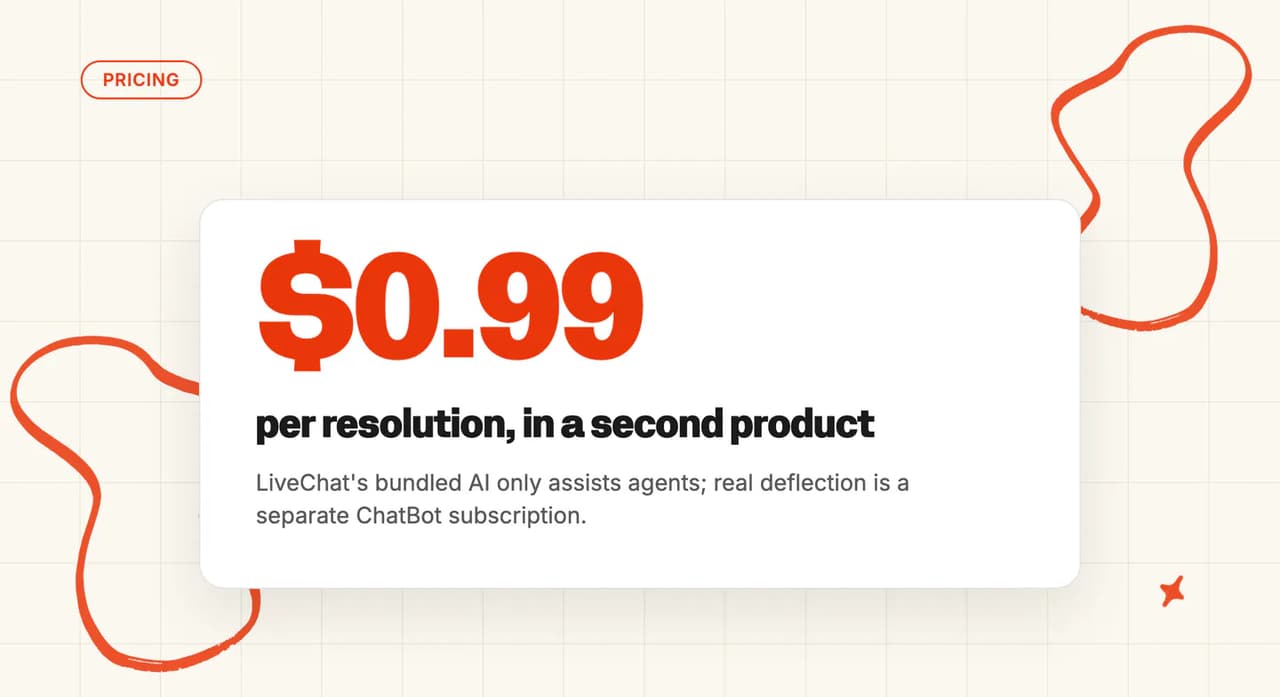
The problem is that the AI most people think they're buying (the kind that answers customers on its own, so your team doesn't have to) isn't the AI bundled into that seat. Real autonomous deflection is a separate product, on a separate subscription, with its own per-answer meter running on top.
You're probably here because one of these is true:
- You saw "AI included" next to the seat price and need to know what real AI deflection actually costs on the invoice.
- You got a quote (or built a plan) that stacked LiveChat and ChatBot together, and you want a quick way to check whether that's right.
- You're modeling an AI rollout and the per-resolution line is a big question mark you can't get a straight answer on.
This post breaks down every line item across both products, runs the math at three real volumes, quotes what customers say about the invoice, and shows what the alternatives cost at the same scale. No "contact sales" answers. It's the breakdown I wish the pricing page gave you.
How does LiveChat AI pricing actually work?
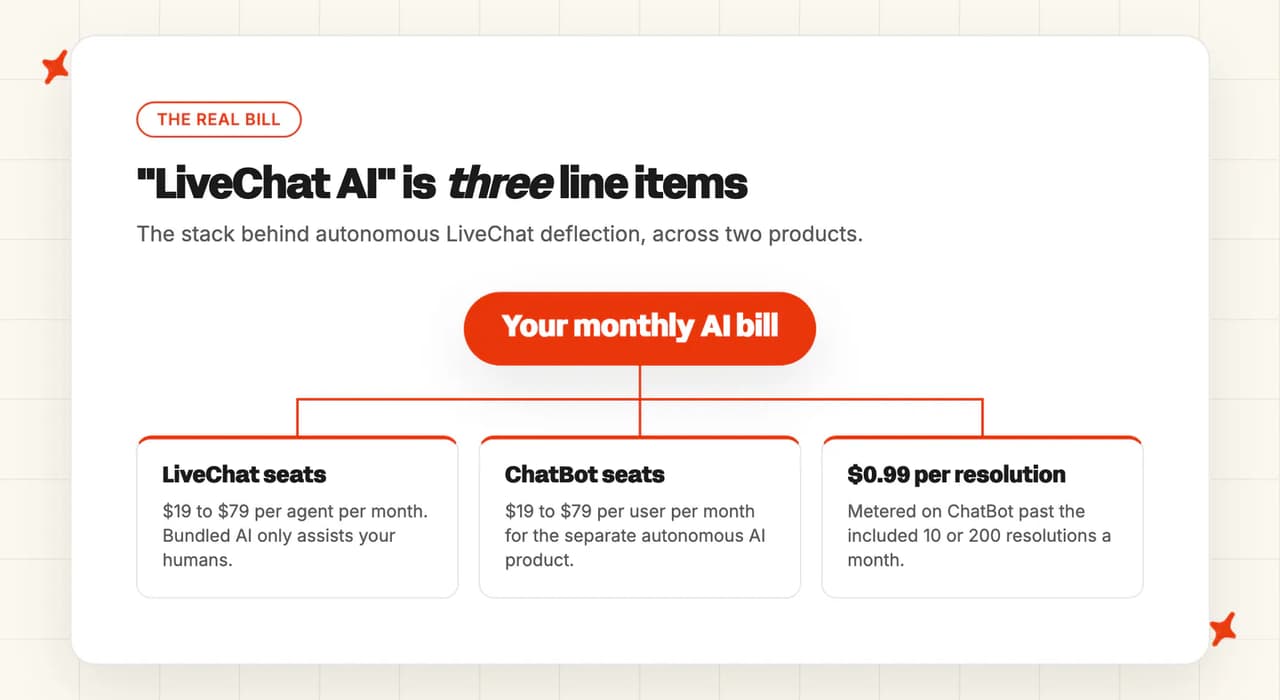
"LiveChat AI" is really two products with two separate bills.
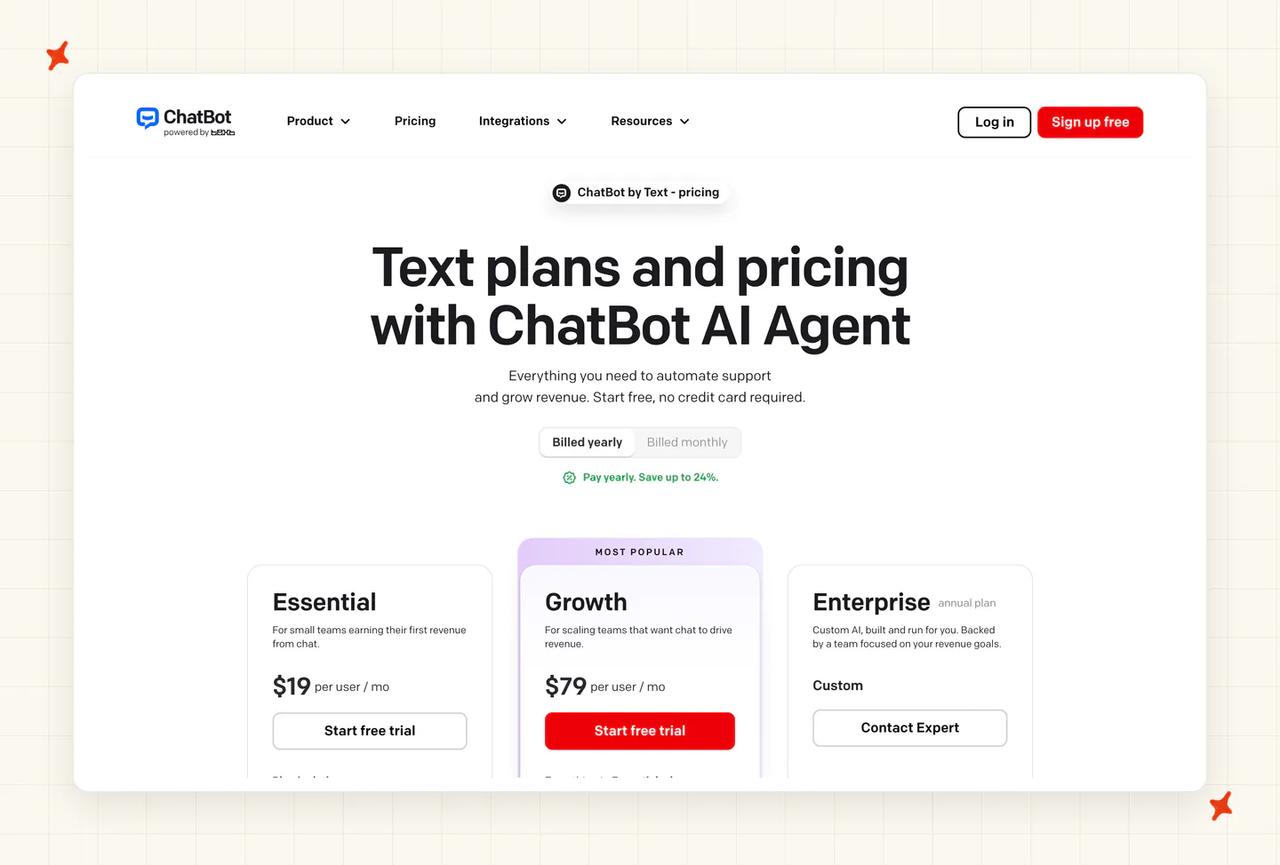
The first is LiveChat itself, the live-chat and helpdesk platform, at $19 to $79 per agent per month. The AI in there ("Text Intelligence", built on a Copilot that used to be called One) is agent-assist.
It drafts replies, summarizes chats and suggests tags to make your human agents faster. It does not resolve tickets on its own.
The second is ChatBot by Text, a separate subscription for the autonomous AI agent that actually answers customers without a human. That's where the deflection you're picturing lives, and it's billed per user plus $0.99 for every resolution past your included allowance. Both products come from the same parent, Text, Inc. (formerly LiveChat Software), which rebranded around the Text umbrella brand in mid-2026 and bolted on agentic "AI Selling Agents".
So the full version of the LiveChat AI bill is three line items across two subscriptions:
| Component | Price | How it's billed | Notes |
|---|---|---|---|
| LiveChat seat | $19 to $79 per agent / mo | per agent, monthly (annual list) | agent-assist AI bundled; does not resolve on its own |
| ChatBot seat | $19 to $79 per user / mo | per bot-builder, monthly (annual list) | separate subscription; Growth tier includes 200 resolutions |
| ChatBot resolutions (included) | 10 (Essential) or 200 (Growth) / mo | included in the seat | a rounding error at real volume |
| ChatBot resolution overage | $0.99 per resolution | $49.50 per 50, auto-refill | the true unit cost of the AI |
| AI Selling Agents / Custom Skills | add-on | quote-based | extra layers from the 2026 rebrand |
| Enterprise (either product) | custom | annual | sales-gated |
If you remember one line item, make it that table. The $0.99 resolution charge is the number that runs your AI bill, and it lives in a product most LiveChat buyers don't realize they need until they're mid-rollout.
What does a LiveChat seat cost, and what AI is actually included?
LiveChat's own plans are refreshingly simple to read, which is part of why the AI confusion happens. On annual billing it's Starter at $19, Team at $49 and Business at $79, all per agent per month (these are the list prices I use in the worked examples below).
Pay monthly and those become $25, $59 and $89. There's a 14-day trial with no card, and Enterprise is custom.
Every one of those plans includes AI, and this is the bit to slow down on. What's included is Text Copilot (reply suggestions, chat summaries, tag suggestions, text enhancement) plus AI Insights, with sentiment analysis in early access on Business.
All of that is agent-assist: it sits next to your human agent and speeds them up. Useful, but it is not an AI that closes tickets while your team sleeps.
LiveChat markets an "up to 80%" AI resolution figure in places, but that number only applies once you've added the separate ChatBot product on top. It's an aspirational ceiling rather than a measured rate (LiveChat's own 2025 report tracks satisfaction and stops short of a headline resolution rate).
So on the LiveChat product alone, the AI in that seat makes humans faster. It doesn't replace them.
Before you scale a plan in a spreadsheet, remember this is per agent, and it compounds (each agent is another recurring seat charge). Reviewers keep calling it out.
On Capterra, one VP of Sales and Operations puts it plainly: "Pricing can get high as you add more agents". A Sales Director on the same platform adds that they "dislike that I have to have a license per user which is not as flexible".
At five agents it's a rounding error. At forty, the seat line alone is a real budget line before any AI resolves anything.
What does ChatBot by Text cost, and what counts as a "resolution"?
This is the product that does the autonomous work, and where the AI meter lives.
ChatBot by Text is billed per user per month on two public tiers. Essential is $19 (annual) with 10 AI resolutions a month and one AI agent; Growth is $79 (annual) with 200 resolutions a month and up to ten agents.
Pay monthly and those are $25 and $99, with a 14-day trial and custom Enterprise. The seats here cover only the handful of people who build and manage the bot (in practice, just a person or two). The resolutions are what scale with your ticket volume; the seat count barely moves.
So what's a resolution? ChatBot defines it as: "the AI directly solved a customer question. Multiple questions in the same chat still count as one."
That's a chat-level definition, and a reasonably fair one (the same as Intercom's "outcome"). If a customer asks three things in one conversation and the AI handles all three, it still counts as a single resolution.
Generous as that per-chat definition is, the included allowance still runs out almost immediately at any real volume. Two hundred resolutions a month sounds generous until you remember that a mid-sized store handling 10,000 tickets, with the AI resolving 70% of them, needs 7,000 resolutions.
The 200 included become a rounding error, and everything above bills at the overage rate (at any real volume, that overage is nearly the entire AI bill).
What do extra AI resolutions cost, and how fast do you hit the cap?
Past your included allowance, ChatBot tops you up automatically: 50 more resolutions for $49.50, on auto-refill, so the AI keeps answering. Do the division and that's $0.99 per resolution, the same rate on every plan.
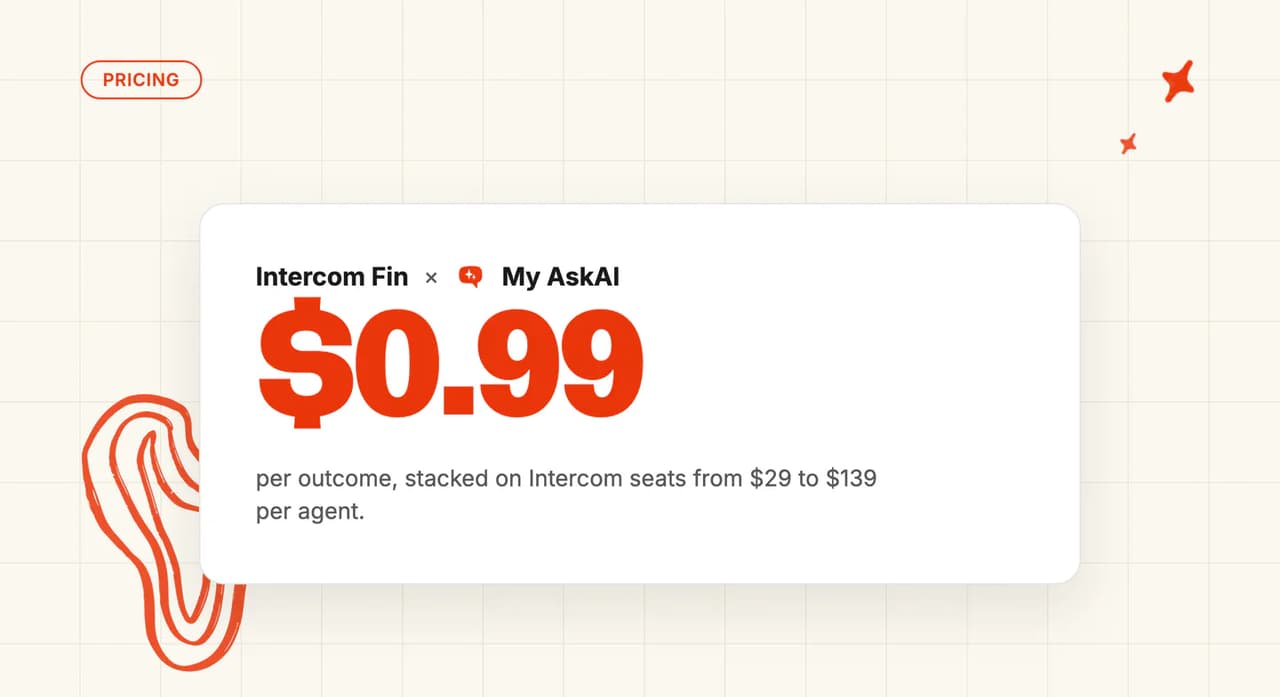
If that number looks familiar, it's because it's exactly what Intercom charges per outcome (the same $0.99, to the cent). Once you're past the small included allowance, LiveChat's autonomous AI costs the same per answer as Intercom, the vendor most buyers file under "premium".
On Growth you get 200 resolutions in the $79 seat. A team doing 10,000 tickets a month at a 70% resolution rate generates 7,000 (that's 35 times the included allowance).
That's 6,800 over the allowance, at $0.99 each, or $6,732 a month in resolution charges alone, before you count a single LiveChat seat. The included 200 covered less than 3% of the work, which is why I'd never bank on that allowance as a real discount.
At real volume, the ChatBot bill is basically the $0.99 meter, and the seat is a footnote.
And because it's a per-resolution meter, it does the opposite of what you want as the AI improves. Get better at support, resolve a higher share of tickets, and the bill climbs with it (a perverse incentive baked into the meter).
What does LiveChat AI cost at typical volumes?
Let's put real numbers on it. Below are three worked examples, at 1,000, 10,000 and 50,000 tickets a month. I'm using LiveChat Team ($49) for the human seats and ChatBot Growth ($79) for the bot-builder seats, plus $0.99 per resolution over the included 200.
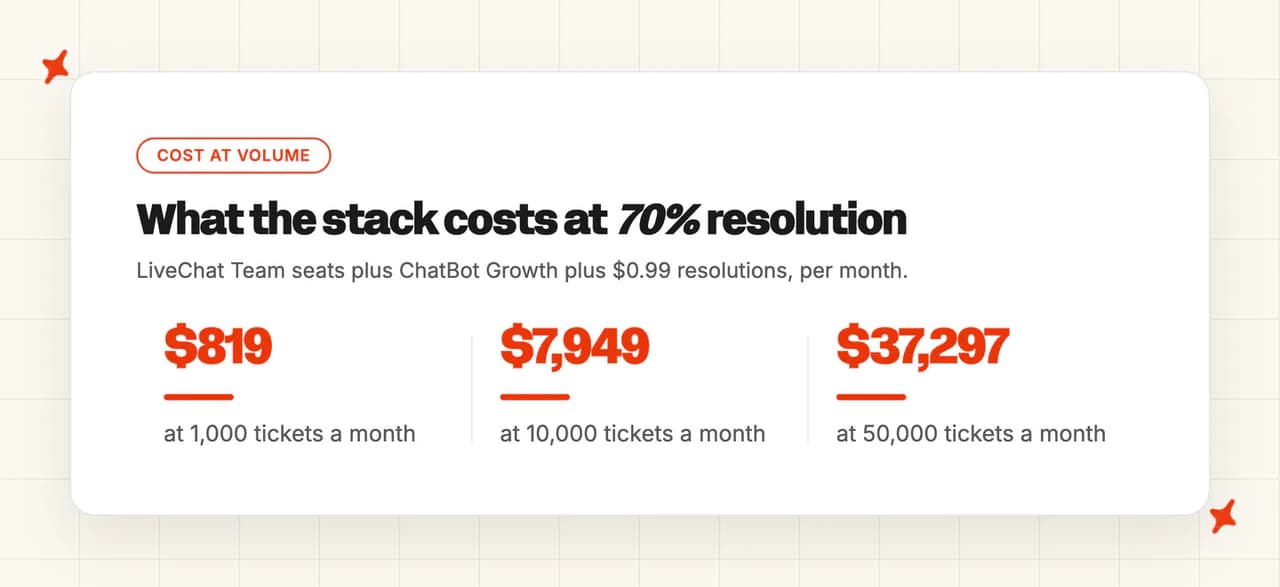
For the resolution rate I've used 70% as the headline, which is the field median across roughly 55 vendors in our own resolution-rate benchmark data. I've shown a conservative 50% alongside it so you can see both. The effective cost per resolved ticket is the number a finance team will ask for, so it's in every table.
At 1,000 tickets a month (small team, 5 agents)
| Line item | At 70% resolution | At 50% resolution |
|---|---|---|
| Resolutions | 700 | 500 |
| LiveChat seats (5 × $49) | $245 | $245 |
| ChatBot seat (1 × $79) | $79 | $79 |
| Resolution overage | $495 (500 × $0.99) | $297 (300 × $0.99) |
| Monthly total | ~$819 | ~$621 |
| Effective cost per resolved ticket | $1.17 | $1.24 |
At this size the seats and the one builder seat are still around 40% of the bill, and the overage is already the single biggest line. The one cheap scenario for LiveChat's AI is below the 200-resolution allowance: a low-volume team barely using deflection pays just the seat, and the AI rides along effectively free (the one setup where the bundled-AI framing holds up). Cross that line, and the meter takes over.
At 10,000 tickets a month (mid-market, 20 agents)
| Line item | At 70% resolution | At 50% resolution |
|---|---|---|
| Resolutions | 7,000 | 5,000 |
| LiveChat seats (20 × $49) | $980 | $980 |
| ChatBot seats (3 × $79) | $237 | $237 |
| Resolution overage | $6,732 (6,800 × $0.99) | $4,752 (4,800 × $0.99) |
| Monthly total | ~$7,949 | ~$5,969 |
| Effective cost per resolved ticket | $1.14 | $1.19 |
At mid-market volume the balance of the bill flips. The resolution overage is now about 85% of the total, and both seat lines together are the footnote. Your AI cost is almost entirely a per-answer meter running inside a second product.
At 50,000 tickets a month (high volume, 50 agents)
| Line item | At 70% resolution | At 50% resolution |
|---|---|---|
| Resolutions | 35,000 | 25,000 |
| LiveChat seats (50 × $49) | $2,450 | $2,450 |
| ChatBot seats (5 × $79) | $395 | $395 |
| Resolution overage | $34,452 (34,800 × $0.99) | $24,552 (24,800 × $0.99) |
| Monthly total | ~$37,297 | ~$27,397 |
| Effective cost per resolved ticket | $1.07 | $1.10 |
At high volume the overage is around 92% of the bill, and the effective cost per resolved ticket barely moves, because the unit price is fixed at $0.99 with no public volume discount (none that we've seen published, anyway). The only lever left is an Enterprise negotiation. A rising resolution rate here, the thing you're working hard to achieve, just means a bigger number.
What the LiveChat pricing page doesn't tell you
Three costs catch teams out mid-deployment, and none of them are on the pricing page. I flag all three before anyone commits.
The AI you actually wanted is a second subscription
This is the big one. You budget for LiveChat, see "AI" on every plan, and only discover during rollout that autonomous deflection means buying and running ChatBot as well (a whole second subscription with its own bill).
Reviewers feel the wider pattern. On G2, customers describe features that used to be bundled now being split into separate paid products you buy one by one. For AI, that separate product is ChatBot, and its meter is the $0.99 resolution charge.
Per-agent seats compound
Covered above, but worth repeating as a budget item: at 20 to 50 human agents the LiveChat seat line alone is $980 to $2,450 a month before any AI runs. It's the quiet base cost I add in first, under everything else.
Annual framing and billing rigidity
The headline prices are annual billing; pay monthly and it's 25 to 30% more (worth doing that annual-versus-monthly math before you sign). And the billing terms around ChatBot are strict.
On Capterra, one customer describes being charged for two months when they needed one: "The billing process starts when you order the software... it meant we would have to pay for 2 months of the program when we only needed it for one".
Another, who upgraded by accident and canceled almost immediately, writes on Capterra: "Did not even use any of the features at all. Of course they DECLINED to refund or even pro rate".
What real LiveChat and ChatBot customers say about the invoice
I went through Capterra for billing-specific complaints on both products. The short version: the money complaints are moderately common though not overwhelming, and they cluster among small teams and low-volume users where the per-seat and separate-product stacking hurts most.
Most reviewers still rate the core product well. But the pricing pattern is consistent enough to name (and worth pressure-testing against your own volume before you commit).
On LiveChat, the recurring theme is per-agent cost creep. A founder and CEO writes on Capterra: "The pricing is something that could be improved. It feels a bit high".
Paired with the earlier "pricing can get high as you add more agents", I read it as a product that's cheap to start and expensive to scale.
On ChatBot, the theme is that the entry price feels steep for what a small team gets. One reviewer puts it bluntly on Capterra: "The price is crazy. Even the smallest package is more expensive than most".
That tracks with the math: $79 a month for Growth before you resolve anything, and $0.99 a resolution after the first 200, is a lot for a store handling a few hundred tickets a month. I wouldn't sign a small team up for that.
This model pinches at both ends. It gets uncomfortable at the low end, where a small team pays for two products, and at the high end, where the $0.99 meter compounds. Check both against your own ticket numbers first; the comfortable middle is narrow.
Does LiveChat have a free trial, and what are the contract terms?
Yes. Both products offer a 14-day free trial with no credit card (one trial each, on separate accounts), on LiveChat and on ChatBot. That's shorter than some rivals but long enough to test setup and answer quality.
A few contract points to keep in mind. The headline prices assume annual billing; monthly costs meaningfully more, and Enterprise on either product is custom (the only place the $0.99 rate is likely to move).
As the reviews above show, the billing terms around cancellations and proration are strict, so read the renewal terms before you commit annually. There's a help page on choosing the right plan, but it won't tell you what you'll pay once the AI is doing real volume (the resolution meter never shows up there). The worked examples earlier will.
How does LiveChat AI pricing compare to the alternatives at the same volume?
Let's line the LiveChat-plus-ChatBot stack up against the alternatives at the 10,000-ticket volume, at a 70% resolution rate, so it's apples to apples.
| Vendor | Pricing model | Cost at 10k tickets (70%) | Effective cost per resolved ticket |
|---|---|---|---|
| LiveChat + ChatBot by Text | Per-agent seats across two products + $0.99 / resolution | ~$7,949 | $1.14 |
| Intercom Fin | $85 / seat + $0.99 / outcome | ~$8,630 | $1.23 |
| Tidio Lyro | Per "Lyro conversation" tiers; sales-gated above ~1,000 | not published | not published |
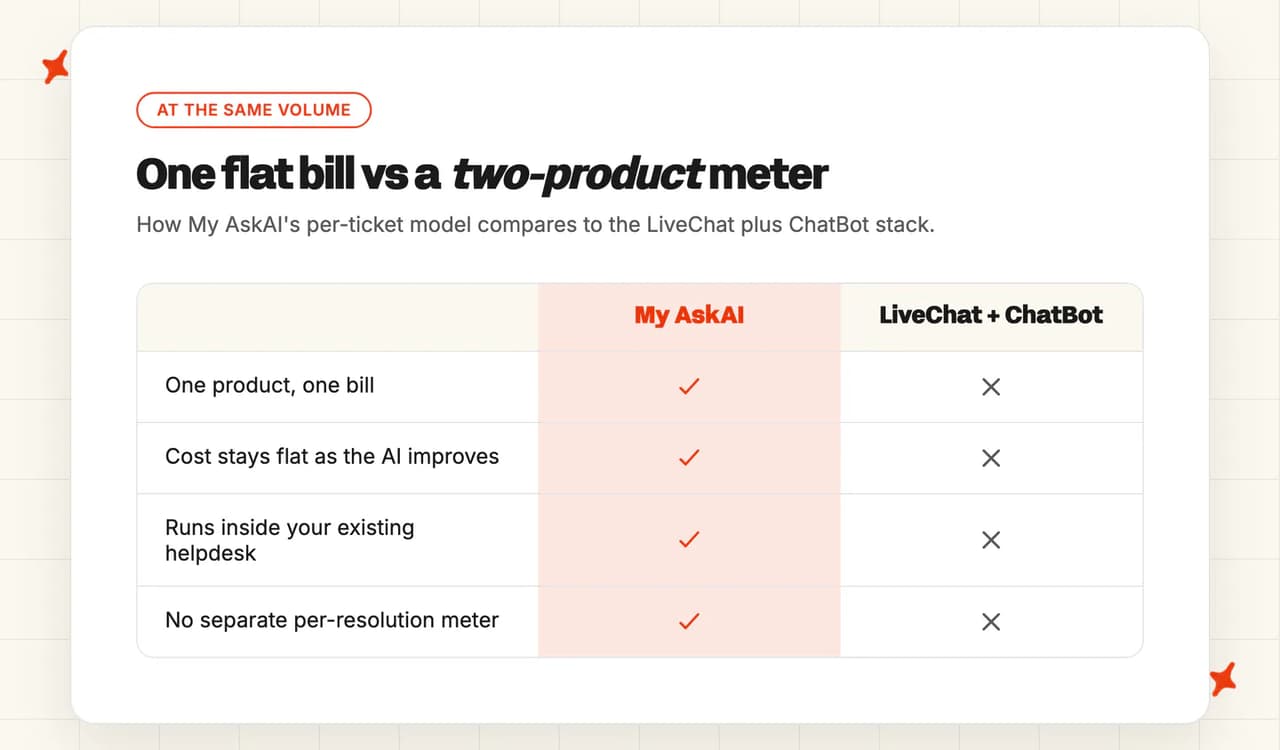
| My AskAI (Scale) | Flat $0.10 per ticket (usage-based) | ~$1,299 | ~$0.19 |
A few notes on this table. LiveChat-plus-ChatBot and Intercom Fin land within a few hundred dollars of each other, which makes sense: they share the same $0.99 unit, so they share the same cost curve (which surprised me the first time I ran the two side by side).
Tidio Lyro starts cheap for tiny volumes, but its per-conversation pricing goes opaque above about 1,000 conversations, with the high-volume Premium tier quoted by sales. I've left it blank. A vendor that won't publish prices at the volume you care about is telling you something.
My AskAI is the outlier on price because we charge per ticket. Per resolution is the model we deliberately avoid.
It's a flat $0.10 a ticket on our Scale plan, which works out to about $1,299 a month at 10,000 tickets and doesn't change whether the AI resolves 50% or 90%.
That's roughly six times cheaper than the LiveChat stack at this volume. The one scenario where LiveChat comes out cheaper is really low deflection volume, under about 200 resolutions a month, where ChatBot's included allowance covers you and you pay only the seat.
The deeper difference is what happens as the AI gets better. Under a per-resolution model like ChatBot's or Fin's, improving your resolution rate raises your bill (the better it works, the more you pay).
Under our usage-based model the bill stays flat, and the cost per resolved ticket actually falls as resolution climbs. That's because most of what makes an AI resolve more (better knowledge, connected tools, tuned guidance) is work you did, and the vendor had no hand in it. We think you should keep the upside of that work.
Is LiveChat AI actually worth the money?
It depends entirely on which AI you mean and how much of it you'll use.
If you're after the full feature picture beyond the pricing, our LiveChat AI guide covers what the AI can and can't do. And if the two-product, per-resolution stack is the part putting you off, My AskAI is the flat-rate, single-bill alternative that runs inside your existing helpdesk.
FAQs
Is LiveChat's AI included in the price, or is it a separate product?
Both, depending on what you mean by AI. Agent-assist AI (reply suggestions, summaries, Copilot) is included in every LiveChat seat. Autonomous AI that resolves customer questions on its own is a separate product, ChatBot by Text, on its own subscription.
What is Text Intelligence, and is it an autonomous AI agent?
Text Intelligence is LiveChat's bundle of agent-assist features: Copilot, reply suggestions, chat summaries, tag suggestions and AI Insights. It helps your human agents work faster. It is not an autonomous agent that closes tickets without a human; that's what the separate ChatBot product is for.
How much does ChatBot by Text cost, and how is it billed?
ChatBot is $19 per user a month (Essential, 10 resolutions included) or $79 per user a month (Growth, 200 resolutions included) on annual billing. On top of that, it's $0.99 for every resolution beyond your allowance, sold as 50-packs at $49.50 on auto-refill.
What counts as a "resolution" in ChatBot?
ChatBot defines a resolution as the AI directly solving a customer question, and multiple questions in the same chat still count as one. It's a chat-level definition, so a conversation where the AI answers several things is billed as a single resolution.
How much does LiveChat AI cost per resolution?
For autonomous resolutions through ChatBot by Text, it's $0.99 each once you pass your plan's included allowance (10 on Essential, 200 on Growth). That's the same per-answer rate as Intercom Fin.
Does LiveChat charge per agent or per resolution?
Both, across the two products. LiveChat's live-chat seats are per agent per month. ChatBot's autonomous AI is per builder-seat plus $0.99 per resolution over the allowance, so a full deployment pays all three (two seat lines plus the per-resolution meter).
Is there a minimum monthly spend for LiveChat or ChatBot?
Effectively the cost of one seat. LiveChat starts at $19 per agent a month; ChatBot starts at $19 per user a month with 10 resolutions included. There's no separate per-resolution minimum, but the small included allowances push you into overage quickly (10 or 200 resolutions, against thousands of real tickets).
What does LiveChat AI cost at 1,000, 10,000 and 50,000 tickets a month?
Using LiveChat Team seats plus ChatBot Growth plus $0.99 resolutions at a 70% resolution rate, it's roughly $819 a month at the smallest tier, $7,949 at the middle one and $37,297 at the largest. The resolution overage dominates the bill from mid-market volume up, so budget around that line.
Does LiveChat have a free trial, and what are the contract terms?
Both LiveChat and ChatBot offer a 14-day free trial with no card. Headline prices are annual billing; monthly costs 25 to 30% more. Enterprise is custom, and cancellation and proration terms are strict, so I'd read the renewal terms before committing annually.
How does LiveChat AI pricing compare to Intercom Fin or My AskAI?
At 10,000 tickets and a 70% resolution rate, the LiveChat-plus-ChatBot stack is about $7,949 a month and Intercom Fin about $8,630, because both use a $0.99 per-answer unit. My AskAI is about $1,299 a month flat, because it charges $0.10 per ticket, with no per-resolution meter.
What's the difference between LiveChat, ChatBot, HelpDesk and Text?
They're all products from Text, Inc. LiveChat is the live-chat platform, ChatBot is the autonomous AI agent, HelpDesk is the ticketing tool and KnowledgeBase is the help-center builder.
Text is the 2026 umbrella brand that ties them together. For AI pricing, the two that matter are LiveChat (agent-assist, bundled) and ChatBot (autonomous, separate and metered).